
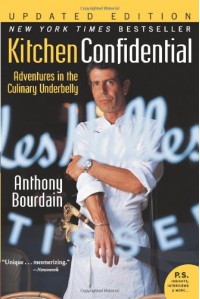
 After reading this book, you may never eat in a restaurant again — at least an expensive one, and you'll certainly never order fish on a Monday or order your meat well done (bad cuts are never thrown out because they can always be saved for the customer who orders well-done, " dumb bastard is paying for the privilege of eating the garbage." Hollandaise sauce is always a risk because to maintain its proper consistency it needs to be close to room temperature, which is ideal for the growth of those nasty little bugs that cause gastrointestinal unpleasantness. Never eat in a restaurant where the bathroom is anything other than spotless. Bathrooms are easy to clean, kitchens are not, and if they don' care enough to keep the bathroom clean, they are unlikely to work on the kitchen that no one sees. And, by the way, " special" is most likely yesterday' something else. " is boring. Chefs see it as a menu item for those people who don' know what they want to eat. . . . Margarine? That' not food. You can' believe that' not butter? I can. If you plan on using margarine in anything you can stop reading now, because I won't be able to help you." Bourdain is a well-known New York chef of Les Halles (Culinary Institute of America-trained and author of two culinary mysteries) who writes with great humor about the unseen parts of a restaurant. That ritzy, elegant meal of foie gras drizzled with some phenomenal sauce is probably the collaborative effort of " out moral degenerates, dope fiends, refugees, a thuggish assortment of drunks, sneak thieves, sluts and psychopaths." Bit it' still quite a ballet and a feat to get everyone' order done at the same time, so dependability and consistency are prized by chefs as the highest job requirements. Personal backgrounds are irrelevant. Bourdain begins his book with the warning: " will be horror stories. Heavy drinking, drugs, screwing in the dry-goods area, unappetizing industry-wide practices. Talking about why you probably shouldn' order fish on a Monday, why those who favor well-done get the scrapings from the bottom of the barrel, and why seafood frittata is not a wise brunch selection. . . . But I' simply not going to deceive anybody about the life as I' seen it." You may never eat in a restaurant again, but you' gain an appreciation for the enormous difficulty of running a restaurant. Bourdain takes us through the typical day at Les Halles. You have to be nuts to want to be a chef. It's the most hectic, crazy, unending day. To be fair he contrasts his day with that of Scott Brick, a three-star restaurant chef, whose work style is much less frantic, but equally demanding. His chapter on how to prepare food like a great chef is terrific and filled with all sorts of hints — from what kind of knife to buy to how to use garlic: throw out that abomination, the garlic press, no real chef would ever have one. This book should be mandatory reading for anyone interested in becoming a chef. Very enjoyable and very funny.
EricCWelch
After reading this book, you may never eat in a restaurant again — at least an expensive one, and you'll certainly never order fish on a Monday or order your meat well done (bad cuts are never thrown out because they can always be saved for the customer who orders well-done, " dumb bastard is paying for the privilege of eating the garbage." Hollandaise sauce is always a risk because to maintain its proper consistency it needs to be close to room temperature, which is ideal for the growth of those nasty little bugs that cause gastrointestinal unpleasantness. Never eat in a restaurant where the bathroom is anything other than spotless. Bathrooms are easy to clean, kitchens are not, and if they don' care enough to keep the bathroom clean, they are unlikely to work on the kitchen that no one sees. And, by the way, " special" is most likely yesterday' something else. " is boring. Chefs see it as a menu item for those people who don' know what they want to eat. . . . Margarine? That' not food. You can' believe that' not butter? I can. If you plan on using margarine in anything you can stop reading now, because I won't be able to help you." Bourdain is a well-known New York chef of Les Halles (Culinary Institute of America-trained and author of two culinary mysteries) who writes with great humor about the unseen parts of a restaurant. That ritzy, elegant meal of foie gras drizzled with some phenomenal sauce is probably the collaborative effort of " out moral degenerates, dope fiends, refugees, a thuggish assortment of drunks, sneak thieves, sluts and psychopaths." Bit it' still quite a ballet and a feat to get everyone' order done at the same time, so dependability and consistency are prized by chefs as the highest job requirements. Personal backgrounds are irrelevant. Bourdain begins his book with the warning: " will be horror stories. Heavy drinking, drugs, screwing in the dry-goods area, unappetizing industry-wide practices. Talking about why you probably shouldn' order fish on a Monday, why those who favor well-done get the scrapings from the bottom of the barrel, and why seafood frittata is not a wise brunch selection. . . . But I' simply not going to deceive anybody about the life as I' seen it." You may never eat in a restaurant again, but you' gain an appreciation for the enormous difficulty of running a restaurant. Bourdain takes us through the typical day at Les Halles. You have to be nuts to want to be a chef. It's the most hectic, crazy, unending day. To be fair he contrasts his day with that of Scott Brick, a three-star restaurant chef, whose work style is much less frantic, but equally demanding. His chapter on how to prepare food like a great chef is terrific and filled with all sorts of hints — from what kind of knife to buy to how to use garlic: throw out that abomination, the garlic press, no real chef would ever have one. This book should be mandatory reading for anyone interested in becoming a chef. Very enjoyable and very funny.
Currently reading

Marines and Military Law in Vietnam: Trail by Fire

Breach Of Trust

Glory Enough for All: The Battle of the Crater: A Novel of the Civil War

12, 20 & 5: A Doctor's Year in Vietnam

Shooting Star

Every Contact Leaves a Trace

Lunar Park

Slaughterhouse-Five

All the Pretty Horses

Henry VIII: The King and His Court


