
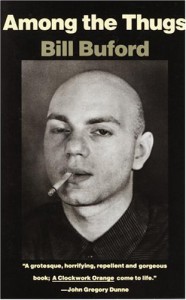
 Bill Buford, an American export to Britain, began an exploration of sports violence after he had the misfortune to take a train that was being systematically destroyed by hundreds of Liverpool soccer team supporters - the police seemingly unable to control the riot, indeed as afraid as the other passengers. There is a particularly savage image of a drunk "supporter," as Buford calls the hooligans, throwing lighted matches on the shoes of a well-to-do businessman riding in first-class, perhaps hoping to set the man's pants on fire, the man trying to ignore the barbaric gesture. To Buford, this act became symbolic of the revolt of the unemployed and uneducated against class distinctions: sports fans "determined to break or destroy the things that were in their way."
Buford's English friends were not surprised; this was normal behavior for the "lads." What did surprise them was that Buford had never been to a soccer match. So they took him. It was quite an event:
spectators urinating on one another, fighting, manhandling the police, wrestling for their seats. Buford decided to investigate "them."
Some of the behavior Buford attributes to the design of English football (soccer). The spectators become crowds. There are not enough seats for all; most stand to watch and are pressed together in a remarkable intimacy during the game. When they leave, the observers must exit through narrow gates and are forced to herd together in a fashion Buford could only describe as a stampede. Indeed, they are fenced in (often with chain linked fences topped with several rows of barbed wire curved ill towards the spectators) during the match in conditions much like a stockyard. Buford recalls one match: "the single toilet facility overflowing, and my feet slapping around in the urine that came pouring down the concrete steps of the terrace, the crush so great that I had to clinch my toes to keep my shoes from being pulled off, horrified by the prospect of my woolen socks soaking up this cascading pungent liquid still warm and steaming in the cold air. The conditions are appalling, but essential: it is understood that anything more civilized would diffuse the experience."
Unfortunately, the type of fan that enjoys this experience is also one that the British National Front, the neo-Nazi party, believes is most responsive to its race-baiting, jingoistic, xenophobic literature and propaganda, and they do their very best to enlist cadres of football fans into groups that revel in violence and class hatred.
The truly scary revelation of this book is Buford's discovery of how easily he became part of the crowd and began to act just like them. Crowds are mindless. Crowds are primitive, barbaric. childish, fickle, unpredictable, capricious, dirty. and vicious. Crowds kill. They killed Jesus and Socrates. They murdered at the Bastille, in Mississippi, and in front of the Wmter Palace. People in crowds are typically those who have "abandoned intelligence. discrimination, judgment. " They are "unable to think for themselves, are vulnerable to agitators, outside influences, infiltrators, communists, fascists, racists, nationalists, phalangists, and spies."
Why have people adopted this manner of behavior? Is it biological, innate to our species, or does it result from environmental conditions, overcrowding and poverty? Buford theorizes that the English working class has essentially disappeared, that most jobs are "service" or white collar. "This bored, empty, decadent generation consists of nothing more than what it ap~s to be. It is a lad culture without mystery, so deadened that it uses violence to wake itself up. It pricks itself so that it has feeling, bums its flesh so that it has smell."


