
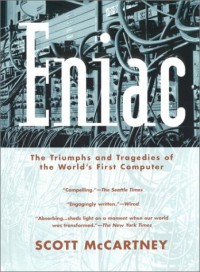
 I really enjoy reading books about the history of technology, and this
audio book was particularly fascinating. World War II created a demand
for lots of number crunching, especially for the development of artillery tables. Human computers — hence the origin of the word for the hardware we all use today — were women who had been math majors. They were recruited in droves to laboriously perform the intricate computations that governed the positioning of field pieces. The tables were all predicated on the environmental conditions in Texas, and unfortunately when they tried to use them in North Africa, they discovered the nature of the soil was so different that it affected the firing of the guns, and the tables were worthless.
Teachers and professors had been inducted by the thousands, so when two otherwise less than spectacular individuals presented themselves at the Moore School of Electrical Engineering at the University of Pennsylvania they were welcomed. J. Presper Eckert and John
Mauchly were very different kinds of individuals but they complemented each other nicely. Eckert had an engineer's desire for perfection and getting something to work, Mauchly was driven was a desire to find a device that would help him solve the intricate computations
needed to predict the weather. Mauchly had gotten his Ph.D. in the thirties, and his first job was teaching at Ursinus College where he enlisted his students to use elementary mechanical calculators to do the staggering numbers of calculations required to determine weather patterns. He began playing around with circuits and electronics, knowing there must be something better. He was intrigued by the work being done at Swarthmore College with vacuum tubes. These newfangled devices had the ability to turn off and on very quickly. They were
being used to count cosmic rays, so Mauchly wondered if they might have an application for his calculator. Could they be used to replace the pins in a mechanical device he wondered. They would be much faster. Eckert had been a tinkerer all his life, building assorted machines and electrical devices. He wanted to attend MIT, but his parents could see no value in a career in physics or engineering, so he was sent to the University of Pennsylvania to study business. He soon switched to the Moore School after becoming bored. He became bored easily and once fell asleep during a class taught by the dean. He created a little device
that he took to dances that would measure the intensity of a kiss by simply measuring the moisture on a couple’s hands. His first patent was for a mechanism to use light to record sound on motion picture film, and it worked much better than what was in current use, but it
never caught on.
The idea that electronics could be used to create a super-fast calculating machine was pooh-poohed by those trained in traditional principles of science, but the army, desperate for a assistance with their artillery tables was willing to try anything. RCA and the experts in vacuum tube technology had told them what they were doing was impossible. Reliability just wasn’t there. Soon Mauchly and Eckert had come up with a design that used some 18,000 vacuum tubes and required miles of wires to connect them all. Eckert discovered that if he ran the
tubes at 10% of the rated voltage, the tubes would last much longer with far fewer failures.
That was to be a significant realization, as they obviously could not be replacing vacuum tubes all the time. Eckert did lots of research. He was such a perfectionist that he did studies with starved mice to see if there were cables that the mice would not chew on or eat even when extremely hungry, and that was the only kind of cable he would permit in the machine. The machine took up a large room and generated a considerable amount of heat and used much energy. The project was not actually completed until just after the war, but it was an astonishing feat, the first time an electronic machine had been able to make decisions based on a calculation (it had if-then statements built in to it).
Once the machine was completed and working, it became obvious to many in the university that they had a potential goldmine, and other faculty, including the famous John Van Neumann, tried to claim credit for their work. The university administrators made a bad tactical error by insisting that all patents be turned over to the university, a break with tradition at the time, and this caused such hard feeling that both men left Penn just five weeks after the unveiling of the machine. The chance to become the computer/ technological capitol of the country — that Boston was to become — was lost for Philadelphia.
Also of interest is The Soul of a New Machine albeit very dated now.


