
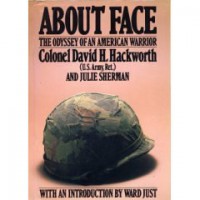
 Colonel David Hackworth is one of America's most decorated soldiers. He was a "mustang," an officer who came up through the ranks. In Hackworth's case he was commissioned on the Korean battlefield. His book describes his love affair with the army, and how he felt our actions in Vietnam destroyed the trust he had in that institution. Soldiers fight often for their friends and comrades rather than for a glorified ideal. Small units develop a unity that perhaps most civilians fail to appreciate. They have to trust each other under very difficult conditions. "The incredible bonding that occurred through shared danger; the implicit trust in the phrase 'cover me' — these were the things that kept me going, kept me fighting here in Korea, and why I'd come back for more. . . ."
One often gets a sense of culture shock reading Hackworth's memoirs. For example, he belonged to an elite combat unit and as all such units are wont to do, they created an emblem for themselves, in this case, a skull. When Korean laborers saw the new sign, they immediately decamped. When asked why, they replied they could not work for anyone who had such little regard for human beings that he could do such a thing. "All of us may have become jaded enough to think the sign was a real masterpiece, but to the poor Koreans our attitude was simply barbaric."
Hackworth's reflections on the post-Korean army are instructive. Eisenhower and Chief of Staff Maxwell Taylor were engaged in a large restructuring of the armed forces; a conversion to a nuclear oriented service that required more training and fewer people. Morale was decimated, according to Hackworth when those with even one day less than the eighteen years required for permanent duty were RIF'd or given the option of remaining at a lower grade. Colonels were reduced to master sergeants over night. Battalions were eliminated and reorganized into five rifle groups designed for a nuclear battlefield. This became known as the Pentomic Army that was later eliminated as unworkable. Of more concern, was the insistence on "zero-defects."
Hackworth suggests the competition to be perfect led to "M-1 penciling." It was discovered that a pencil would make a hole in a cloth target that was identical to the hole made by an M-1 bullet. Soon units were turning in great marksmanship scores. Cheating in all manner of things became rampant. Perhaps the swindling had begun with the Korean Certificate of Loss statements where commanders would allow their troops to inflate kill records, "I don't know, but the Post-Korea Army had an unquenchable thirst for perfection which parched the throats of even the most desiccated leaders, and the M-1 pencil was the only water to be found. A CO simply couldn't fail. . . . Our sham of perfection set an unspoken precedent for bigger lies down the road, each and every one of them would ricochet back on the Army as an institution, with the repercussions of it all enough to shake America to its core."


